0:05
Good afternoon and welcome to the Good
0:07
Plates Kitchen. Today we're making
0:11
chicken with grapefruit and thyme. And
0:15
here's our chicken. And this is a
0:18
grapefruit. This is ruby red grapefruit.
0:20
So, it'll be nice and sweet. And we have
0:24
thyme. And of course, we have beautiful
0:29
Believe it or not, this is a
0:34
pepper grinder. Okay. And uh we'll get
0:37
started in a minute. First thing we're
0:39
going to do is we're going to season the
0:41
chicken. So that means seasoning it with
0:46
Put some salt on there
0:51
and freshly cracked black pepper.
0:59
Push it in with your hands
1:02
and move the chicken around so that you
1:05
can get the other ones.
1:13
Notice I put the salt and pepper both in
1:16
their own little container. That is to
1:19
prevent crosscontamination, which is a
1:21
real issue. So, I have been putting my
1:24
hands inside with the chicken
1:29
and I don't want to spread that
1:32
salt to something else
1:37
and cross-contaminate it.
1:40
See? So, I go like that
1:42
and then turn them over.
2:46
Now, this is going to give your chicken
2:49
some nice flavor. We're going to put it
2:51
in the refrigerator until it's time to
2:54
cook it and it'll sit there nicely and
2:58
it'll absorb the flavors. And then we'll
3:00
be back. And we're back. The chicken has
3:03
been sitting marinating
3:05
in the refrigerator with some salt and
3:10
fresh black pepper. And now we're going
3:12
to cook that chicken in a cast iron
3:18
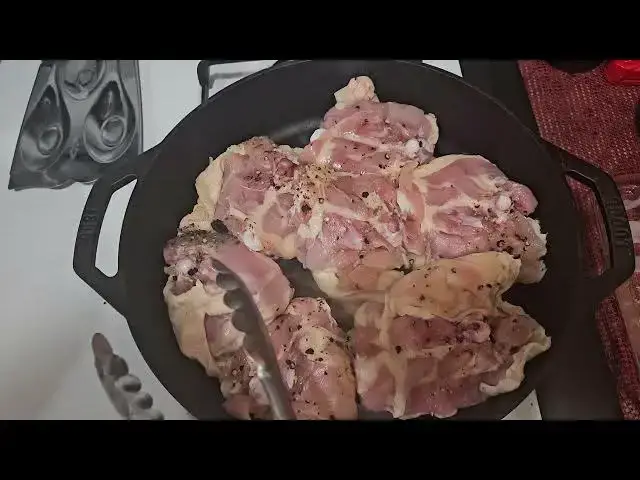
This cast iron skillet has been heated
3:22
up and we're going to check its
3:23
temperature right now.
3:35
That's good. And I'm going to put the
3:37
chicken directly in skin side down. We
3:40
don't need to put any oil. The reason
3:42
why we don't need to put any oil is
3:44
because the pan is already hot. And what
3:51
automatically starts to render.
3:54
And when the skin renders,
3:57
it doesn't need any oil.
4:00
And because it's already hot, it won't
4:06
We have to let it sit there for few
4:08
minutes to let it render. Always chicken
4:12
is always skin side down.
4:41
You can hear it rendering. One thing to
4:44
be careful of is not to crowd the
4:47
chicken too much because if you crowd it
4:49
too much, what happens is the chicken
4:53
As it reduces reduced,
4:57
it'll boil and you don't want boiled
4:59
chicken. So, I have a lot of chicken.
5:04
I'm going to take this one.
5:07
See, it didn't stick at all. And put it
5:09
in another pan. I have another pan
5:14
And rearrange these guys with no
5:23
No sticking. This is a very classic
5:27
French way of preparing chicken. If you
5:31
look back, you might have seen my
5:34
chicken with lemon and garlic
5:38
video. And that is also very very
5:54
and brown. When you're cooking chicken
5:56
like this, use medium heat. Not high
6:00
heat, but medium heat because you don't
6:01
want to burn the chicken. You just want
6:05
it to brown. And this piece is brown
6:09
enough. Let's try this one. Yes.
6:18
What about this guy in the middle?
6:21
Oh, yeah. Very nice. Okay,
6:27
we turned them all around.
6:29
They're all ready to go. Even the extras
6:33
in the other pan. And now we're going to
6:36
let them rest with the top on
6:40
cuz we're looking for
6:49
And we will be using an instant read
6:51
thermometer to take their temperature.
7:00
Get them a little head start on the fl
7:06
I'm going to sprinkle them
7:14
That's French thine. It's a very French
7:21
I'm going to put a little bit of the
7:23
grapefruit juice in there. See?
7:31
Now I'm going to put the top on so
7:33
they'll get that flavor. Okay. And we'll
7:36
be back when they reach the appropriate
7:44
Now, you might be curious about how
7:47
exactly to measure the temperature on a
7:52
chicken thigh, and this is how you do
7:56
the temperature probe in like so.
8:08
Make sure that you're not hitting the
8:09
pan and that you're not hitting the bone
8:13
because that'll give you a false
8:15
reading. So, you want to go into the
8:16
thickest part of the chicken
8:21
thigh and take the reading.
8:25
We'll do it on this one. Oops, that's
8:36
These are definitely done. 164. Perfect.
8:42
we're going to remove the chicken
8:48
I'm going to put it on its serving dish.
8:55
It can sit on the serving dish for a few
8:57
minutes. It'll be fine.
9:09
You see all this beautiful stuff here at
9:12
the bottom of the pan? That is called
9:17
And we really want that.
9:28
And I really want you to understand that
9:30
there was no oil or butter or anything
9:34
put in this pan. And look how much fat
9:37
rendered off of those chicken thighs.
9:45
Okay, now we're going to
9:50
we're going to scrape up all that fond
9:52
with some help of some lovely
9:55
Chardonnay. This is Lindamman's bin 65
10:10
and scrape up all the good stuff.
10:14
And this is a cast iron pan
10:17
so it can tinkle licking and keep on
10:19
kicking just like a mix. They last
10:26
Do not try to do this with a non-stick
10:28
pan because you will scratch it. I
10:31
wouldn't even do this with an enamel pan
10:33
because again it would scratch it. You
10:36
really don't want to scratch it.
10:38
Stainless steel is okay, but
10:41
cast iron is better because it holds
10:46
We're going to throw a knob of butter in
10:52
This will thicken it slightly and give
10:54
it a really good texture.
10:57
Texture is important.
11:01
And here we have it.
11:04
Thanks for joining me. Here's our
11:08
Thanks for watching. See you again on
11:10
the good plate. As always,